

By Sage Hoffman Nadeau, award-winning writer and comparative literature student at the University of Oregon
Sage Hoffman Nadeau is a third-generation Lebanese American writer based in the Pacific Northwest. She is currently studying comparative literature and Arabic, and hopes to use her degree to pursue a career in publishing. In her free time Sage can be found trying new recipes, rock climbing, or thinking up her next story.
Imagine 2200 is a climate fiction short story contest run by Grist, a nonprofit independent media organization reporting on climate change. Accepting applications internationally, this competition sponsors awards for the top three entries with the first prize winning an Environmental Writing Fellowship through Oregon State University’s Spring Creek Project. In the first of this two-part blog series, we interview Sage Hoffman Nadeau about her background, short story, and her perspective on the role of writers in the environmental movement.
Q: Your short story, “Meet Me Under the Molokhia”, won the first place prize for Grist’s Imagine 2200 climate fiction competition. How did you react when you got the news?
A: It was kind of crazy because my best friend’s mom found out about the competition and sent it to me 25 days before the deadline. I thought, okay, I’ll enter. I was working up until the day of the deadline and submitted it. In October, I was having dinner with my dad and I randomly opened an email. I saw it and thought it would be bad news. Then, I actually clicked on it and I just kept reading. My dad asked me what was happening and I was in absolute disbelief. Eventually, I told quite a few people and they were all excited for me. My mom even suggested that I celebrate this win and my birthday at the same time!
Q: What went into developing these characters, what was that process like?
A: I think for the main character, Nadia, I was trying to imagine how I would feel if something magically happened and everyone could go back to Lebanon or wherever they came from and feel safe. I was trying to imagine how I would feel in that scenario. I also wanted to create someone who had the experience of displacement in multiple places. For me, I’ve always felt out of place where I live, even though I’ve always lived here. But mostly, I wanted a hopeful story about someone who is kind of flawed, so there’s room for them to grow.
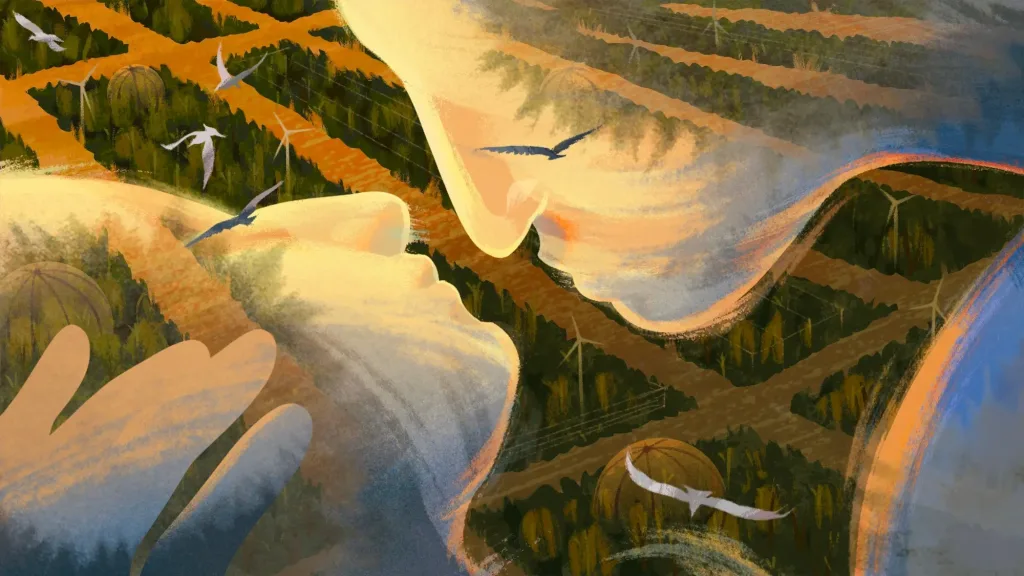
I think sometimes I tell a story because I really want to say something. But in this case it was unexpectedly personal. When I write those personal stories I always have in mind other people who might feel the same way or have similar experiences to the characters. It’s a way to kind of tell my own story but in a way where someone else might see it, and then everyone will feel less alone. I also think that art is a way of connecting people across distance, cultures, or language, so I think part of sharing art is taking responsibility to help make those connections.
Q: It seems like there is a strong sense of longing for Nadia to feel at home in Lebanon and within herself. What helps you stay grounded in your identity?

A: I think my family plays a big role in that. I feel very lucky that a lot of our family history is preserved in some way. I grew up knowing that I am Lebanese. My mom always used to tell me, “we can’t travel to Lebanon because it’s not safe right now”. But there’s a town in Oregon called Lebanon. When I found out someone I knew was from the town Lebanon I got so mad – what do you mean they can drive there in 30 minutes and I can’t go to Lebanon!
I really think food is the way my family has held onto that culture. And so I cook a lot of Lebanese food – stuffed grape leaves and Loubieh are some of my favorites. I think that helps me. Probably the biggest thing for me was learning Arabic, and I’m the first person able to speak Arabic on the American side of our family in a couple generations. That was lost when my great-grandparents immigrated and wanted us to become Americanized. It’s crazy how much you can access culture by speaking the language.
Q: There are many ways of addressing the climate crisis, but sometimes people think first of scientists and policymakers. What role do you think creative writing and speculative fiction plays in helping to envision and create the climate futures we need?
I think storytelling is a really wonderful way because it lowers the access barrier for people to think of solutions. Not everyone can be a world renowned scientist but everyone can use their imagination to think of stories. Stories are really wonderful because they give people hope, and sometimes hope is the most important thing to not giving up. If you have stories to imagine a better future that gives people the ability to fight for that future.
I remember a while back I saw this Ted Talk by Yasser Bahjatt, a scientist from Saudi Arabia, who talked about the predominance of Western perspectives in sci-fi storytelling and that Arab countries and other countries need to have a stronger sci-fi industry because it gives people ideas and hope. For this story, it was important to represent this feeling of climate justice also progressing other justice movements like land sovereignty. I think about it a lot because I want to go to Lebanon and see my family but I can’t, and I feel really sad about that. I wanted to write a story that feeds into this frustration where, in the future, the country has gained their independence because of a scientific advancement and not because they were seen as deserving this independence.
Q: What are your aspirations for your career as a writer?
I would love to be a published author who gets to go on book tours and has special edition books with the book subscription boxes. One of my author role models is R.F. Kuang, she wrote the Poppy War trilogy while she was a PhD student! That’s genuinely insane to me because she wrote a very complicated trilogy of the alternate history of the Opium wars in China. She’s so cool and her books have all these gorgeous special editions and I’m like, I want to be like you.
Q: To anyone who dreams of becoming a creative writer, what message do you have for them?
I feel like the sort of advice that always helped me was, just by writing you’re already a writer. It doesn’t matter if you’re published or not, you’re still a writer. I also think reading a lot is what helped me too, because I got to know what I liked in a book and what I didn’t. It gave me a really good idea of plot – plot structure and plot pacing – and if you generally know what to do you can make a plot work. Even if you don’t read a ton, hearing from another creative can sometimes be nice because they’re someone doing the same thing as you. And mostly just experiment, write a lot, I’ve truly written so much. I wrote a 100-page fan fiction of this obscure book that no one I know has read in middle school and it was insane and it was great practice.
Follow along with Sage’s writing journey through her newsletter and read her most recent published work, “Meet Me Under the Molokhia”.