
Topic:
Identity, Inclusion, and Community Engagement
These blogs all discuss intersectionality within environmental issues, allowing people to share their unique experiences, challenges, and successes as they relate to their personal identity and broader community.
Environmental Issues, Green 2.0 Fellows, Identity, Inclusion, and Community Engagement
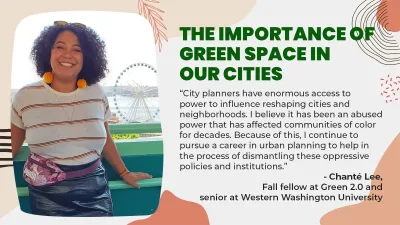
The Importance of Green Space in Our Cities
Chante Lee is a 2021 fall fellow at Green 2.0. She is currently a senior at Western Washington University in Bellingham, Washington where she is finishing her last quarter as an Urban Planning and Sustainable Development major with a focus in Environmental Justice. She has also been extremely involved in the Ethnic Student Center on campus. In addition, Chante has worked at Starbucks part-time as a barista since high school and throughout college. She loves collecting houseplants and cooking new recipes. In this blog post, Chante discusses the importance of green space accessibility and her interest in pursuing urban planning as a career.
Read More 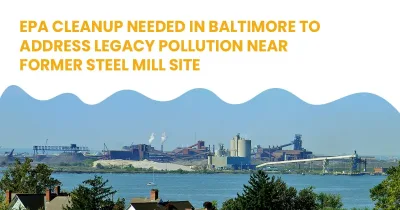
Environmental Issues, Identity, Inclusion, and Community Engagement
EPA Cleanup Needed in Baltimore to Address Legacy Pollution Near Former Steel Mill Site
The Chesapeake Bay Foundation is an independent conservation organization that uses advocacy, education, environmental restoration, and litigation to protect and improve the health of the Chesapeake Bay. In this guest blog post, the foundation examines a case of long-term environmental injustice near Baltimore, Maryland, and how the wrongs of the past could be addressed.
Read More 
Identity, Inclusion, and Community Engagement
Building Power in the Environmental Movement: Event Recap
The State Energy and Environmental Impact Center is an independent non-partisan academic center that supports state attorneys general in their environmental work. In this guest blog post, the Center highlights the perspectives of attorneys of color from the Building Power in the Environmental Movement series, and looks ahead to the next event in the series, which will focus on diversity, equity, and inclusion, and anti-racism in the environmental public sector.
Read More 
Green 2.0 Fellows, Identity, Inclusion, and Community Engagement
Latina Equal Pay Day: People of Color and Women Still Get Paid Less
Juliana Ojeda is the Program Associate at Green 2.0 where she works to support administrative and programmatic operations of the organization. She is a graduate of the University of Florida earning Bachelor’s in Political Science and a minor in Anthropology. Juliana began with Green 2.0 as a 2021 fall fellow. In her first blog for Green 2.0, she writes about what Latina Equal Pay Day means to her.
Read More 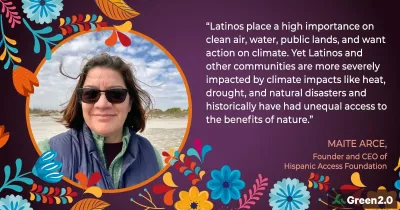
Identity, Inclusion, and Community Engagement
Driven by Culture, Connection and Comunidad
Maite Arce is the founder and CEO of Hispanic Access Foundation. She is an environmental movement leader working to connect Hispanic and Latino communities to the political power of Latinx communities. She lives in Purcellville, Virginia and her ancestral origins are of the Cochimi people of Baja peninsula and her Spanish roots. In this guest blog post to mark the beginning of Hispanic Heritage Month, she shares her motivations and the connections that infuse her passion for nature and community.
Read More 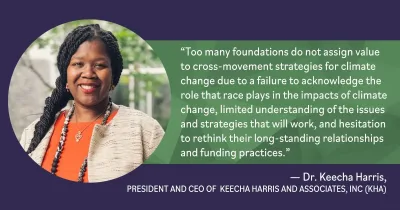
Identity, Inclusion, and Community Engagement
KHA Report Reveals Continued Funding Disparity Between BIPOC and White-Led Green Groups
Keecha Harris and Associates, Inc (KHA), published the Closing the Gap report that quantifies the funding gap between white-led and BIPOC-led environmental nonprofits. In this Q&A with Green 2.0, KHA president Keecha Harris shares more about the initiative. KHA has worked extensively with Green 2.0 on producing the Transparency Report Card and most recently, the Tracking Diversity: The Green 2.0 Guide to Best Practices in Demographic Data Collection.
Read More 
Environmental Issues, Identity, Inclusion, and Community Engagement
Indigenous-Led Marine Conservation Should Be the Future of Our Movement
Angelo Villagomez, senior officer at The Pew Charitable Trusts, is the campaigns manager for Blue Nature Alliance, a global partnership that seeks to protect 18 million square kilometers of ocean in support of the global goal to protect at least 30 percent of nature by 2030. Villagomez, who identifies as Indigenous Chamorro, is a co-author on a recent scientific publication, Advancing Social Equity in and Through Marine Conservation, and in this guest blog post for Green 2.0, he writes about how including Indigenous peoples in conservation can lead to more durable outcomes.
Read More 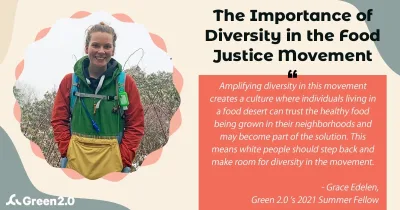
Green 2.0 Fellows, Identity, Inclusion, and Community Engagement
The Importance of Diversity in the Food Justice Movement
Grace Edelen was a recent 2021 summer fellow at Green 2.0 and a graduate of Bellarmine University where she earned a Bachelor of Science in Environmental Science with a minor in Anthropology. She completed her undergraduate research on the effects of climate change on medicinal plants, analyzing how this shift affects Indigenous communities in Ecuador. Grace is passionate about supporting Green 2.0’s mission of making environmental causes more inclusive and equitable.
Read More Identity, Inclusion, and Community Engagement, Organization Programs and Policies
Q+A on Tracking Diversity Guide
Green 2.0 Communications Manager Raviya Ismail discusses the release of Tracking Diversity: The Green 2.0 Guide to Best Practices in Demographic Data Collection (Tracking Diversity Guide) with her colleague Andy Beahrs, Grants Manager.
Read More 
Environmental Issues, Green 2.0 Fellows, Identity, Inclusion, and Community Engagement
Wellness and Inclusivity in the Great Outdoors
Sage Renninger is a fellow at Green 2.0 and a student at Washington State University studying Environmental Science and Sustainability. Honoring National Wellness month, Sage has featured ways in which the outdoors can support physical and mental wellness in our day-to-day lives. Getting outside has helped Sage increase her own physical and mental health, and she believes creating an inclusive space where BIPOC communities can utilize nature is critical in combating systemic injustice.
Read More