
Sharks Don’t Sink: My Journey as a Rogue Shark Scientist and Author
By Jasmin Graham
In her blog, Jasmin discusses her journey and what ultimately led her down the path of becoming an author and co-founder of Minorities in Shark Sciences (MISS).
Jasmin Graham is a shark scientist and environmental educator who specializes in elasmobranch (shark and ray) ecology and evolution. Her research interests include smalltooth sawfish movement ecology and hammerhead shark phylogeny. She serves on the Board of Directors for the American Elasmobranch Society. Jasmin was named the 2021 WWF Conservation Leader. She has a passion for science education and making science more accessible to everyone. Jasmin is the President and CEO of Minorities in Shark Sciences (MISS), an organization dedicated to supporting women of color in shark sciences. She is excited to help open doors for more underrepresented minority students to join the exciting field of marine science.
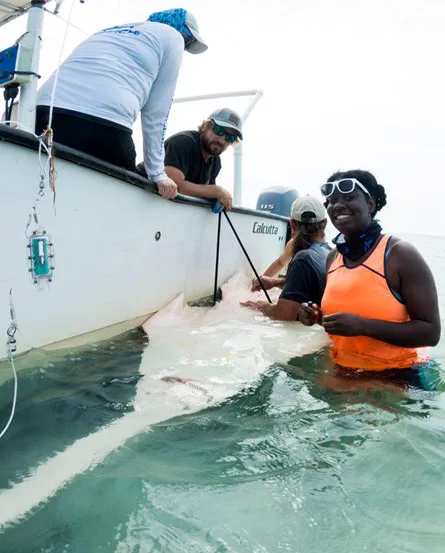
As a girl growing up in South Carolina, fishing with my father felt like pure magic. The ocean was home. But it wasn’t until college that I met a professor studying sharks, and everything shifted. Holding a shark (a bonnethead shark, which is to this day my favorite shark species) for the first time—their sandpaper skin, little hat-like heads—I fell in love with sharks and launched a career in elasmobranch ecology and conservation.
I earned degrees in Marine Biology and Spanish at the College of Charleston and went on to complete a Master’s at Florida State University through the NSF Graduate Research Fellowship Program, studying sawfish movement. In graduate school, I hit a wall. In academia, I experienced isolation, exploitation, and discrimination that left me questioning where I belonged.
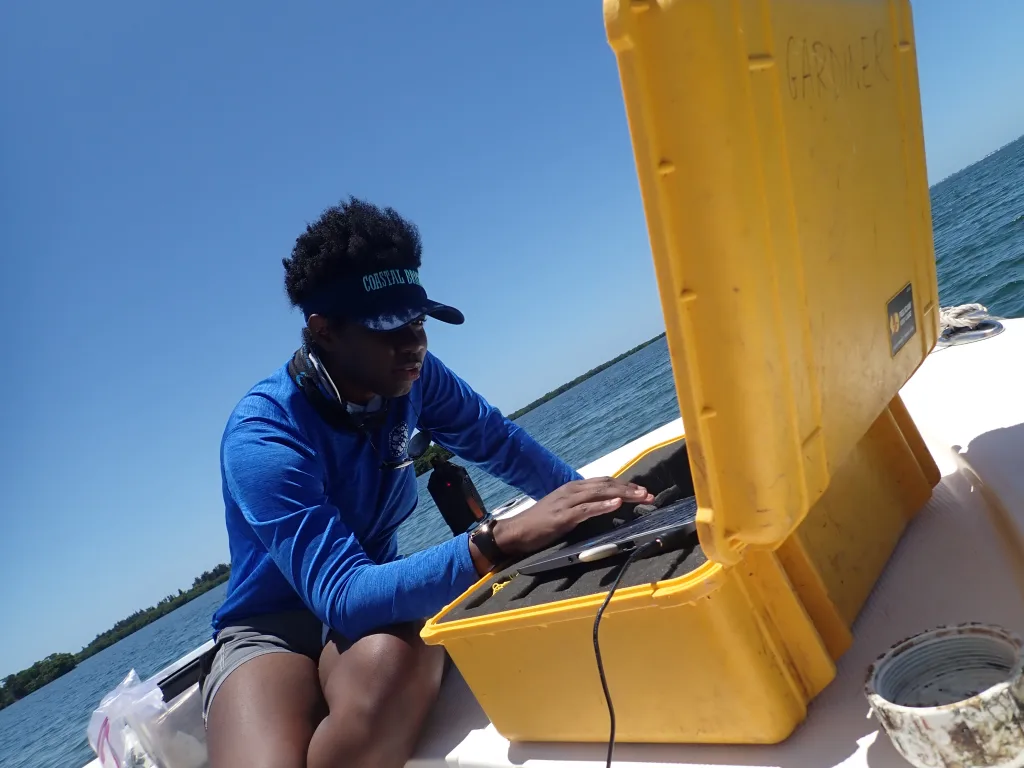
Rather than give up on science entirely, I chose a different route: I left the academic track, walked away from institutional barriers, and declared myself a “rogue scientist.” I co-founded Minorities in Shark Sciences (MISS) with three other Black women scientists to create an inclusive space for gender minorities of color in shark science. Together, we mentor students, conduct research, and share real field experiences.
My journey has been deeply shaped by identity. As a Black woman in marine science—a field historically dominated by White men—I sought to transform the narrative. MISS now includes more than 400 members from around the world, providing community, training, and visibility. Today, when I search “shark scientist” online, I see a colorful kaleidoscope of people—Black, Asian, Indigenous, Latinx—evidence that change is happening.
All of this is woven into my memoir, Sharks Don’t Sink: Adventures of a Rogue Shark Scientist, which aims to demystify both sharks and the scientific path. Sharks have existed for over 400 million years—they teach us that survival means swimming forward. That’s the lesson this book and my life embody: keep going, regardless of whether you ‘float’ naturally in the system or not. I wrote not just for shark lovers, but for marginalized scientists and students searching for a sense of belonging in science. Writing Sharks Don’t Sink also gave me the power to share that story on my terms. The memoir blends storytelling with science, activism with adventure. It chronicles day-to-day life on a boat studying sawfish, academic betrayals that sparked a break, and the founding of MISS as a vessel for change.
Above all, my journey is about belonging and resilience. Sharks—and people—keep moving. They adapt, resist, and persist. As the president and CEO of MISS, I hope this book and our organization empower others to write their own stories in marine science. To remain buoyant. To thrive, no matter what.